Have you thought about learning a new skill like programming or brushing up your creative skillset in filmmaking? Are you naturally curious about why and how everything works?
Together with the General Education Unit, the Technology-Enriched Learning Initiative team will organize a two-day event on October 5 and October 6 to discuss the power of the Internet in making education open and accessible to all. Massive Open Online Courses (MOOCs) are a growing trend worldwide with educational content made openly available to virtually anyone who has access to the Internet. Active practitioners in the field of e-learning will discuss what massive open online courses (MOOCs) are and what they can do for you. A film screening of the award-winning documentary, Ivory Tower, will get you to question the value of higher education and open your eyes to alternative paths of learning. Facilitators will also share their experience with MOOCs and offer insight into its potential to reach new heights in student learning.
The brains and builders behind the Knowledge and Education Exchange Platform (KEEP) visited HKU to demonstrate this one-stop e-learning aggregator on September 21, 2015.
Professor Irwin King, one of the Principal Investigators of KEEP, and also his team from CUHK, demonstrated on how learners can easily fish out relevant education content in a sea of learning materials around the globe. On the other hand, the platform is a hub where teachers are encouraged to share ideas on pedagogical innovation. In the near future, the KEEP team will be focusing their work around learning analytics, gamification, social learning and mobile learning. “We really believe that active learning and more engaged learning is the way for the future, and we want to encourage that,” said Professor King.
Professor Ricky Kwok, Associate Vice-President (Teaching and Learning) at HKU, also made use of the occasion to share HKU’s initiatives in gamification with examples of making the Rubik’s Cube a pedagogical tool in a course on everyday computing, and also designing a game for the MOOC on Epidemics (which is currently on offer). “It’s all about how to engage and incentivize participants to take desirable actions […] we want to make learning happen, that’s why we want to try the gamification idea,” said Professor Kwok.
The two parts of sharing triggered intensive discussions on the floor. The audience was curious to learn the tricks to engage course learners from the beginning to end and to further investigate in how gamification can be meaningfully incorporated in different disciplines.
Over the weekend of 19-20 September 2015, the Technology-Enriched Learning Initiative (TELI) team participated in the EdTech Team Hong Kong Summit, which provided them exceptional insights by the amazing variety of how Google utilized and maximized their apps and projects for teaching and learning.
Google Views- Bringing you to Grand Canyon and More
Mr. Jim Sill, Director of Global Development for EdTechTeam, went on a tour to the Halls of Mirrors in the Palace of Versailles in Versailles with participants.
One of the most inspiring sessions to the team was delivered by Mr. Jim Sill, Director of Global Development for EdTechTeam, on Google Views featuring 360° panoramic photo-taking – a project in which participants go on expeditions and record views for the Google Maps application. There are often places, such as heritage sites, inaccessible by vehicles and made filming of streets by the Google van impossible. Google is therefore recruiting volunteers to carry professional ‘Trekker’ into the bits and pieces of places on Earth. The views collected from places like the Arctic and the Grand Canyon have put all of us in awe, and have also become valuable assets for especially Geography, Architecture and Science students all around the globe to have a glimpse of what the world is like.
At the same session, teammates also learnt about Cardboard, Google’s virtual reality viewer. It allows teachers to take their students on expeditions to almost anywhere they can imagine. Combining the power of panoramic photography and Cardboard, it looks that that field trips, experiential learning and lab simulations will soon take on a whole new meaning. So what’s your idea about making good use of these new technologies?
Organized by Technology-Enriched Learning Initiative
Speaker: Dr. Masato Kajimoto, Journalism and Media Studies Centre Date : 8 October, 2015 (Thursday) Time : 12:45pm – 2:00pm Venue : Room 321, 3/F, Run Run Shaw Building
Abstract:
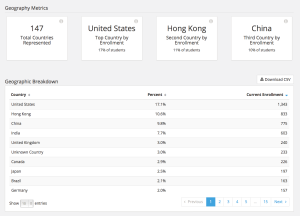
Assistant Professor Dr. Masato Kajimoto from Journalism and Media Studies Centre taught the third iteration of HKU’s online course on edX titled HKU04x Making Sense of News from May to June 2015. The six-week course has attracted more than 7,500 registrations from 147 different countries. It has largely been seen as a successful implementation of journalism-focused media literacy course for the general public and he has been invited to give talks and workshops by different universities that focus on news literacy education.
In this talk, Dr. Kajimoto shares the findings of his investigation into the behavioral data mined through the MOOC in order to illustrate what educators could learn from the learning analytics in terms of curriculum development, instructional design strategies and other pedagogical planning. He then discusses how he has integrated the MOOC into his on-campus teaching.
In order to explore the effective ways to “blend” the two modes of learning experience for the students (namely, face-to-face interactions and self-paced online tuition), he has “flipped” a half of his lectures in the elective course, JMSC1001 Principles of Journalism and the News Media, this semester, which enrolled 127 students from different faculties. He demonstrates how the content has been migrated from edX platform to Moodle while showcasing some of the benefits and challenges he has observed thus far in his experiment.
(1) New Moodle function “Moodle Student Performance by Percentile”
It shows the students’ performance in a Moodle course by 25th, 50th and 75th percentile according to the students’ results in the Moodle Gradebook. This provides information about the performance of the class and may help the teacher give appropriate advice to the students as the course is in progress.
The web page “Moodle Student Performance by Percentile” is accessible via HKU Portal -> “My eLearning” tab -> choose a Moodle course -> click the hyperlink in “Course specific information” section at the bottom of the web page.
(2) Learning Management System (Moodle) and Lecture Capture Service (Panopto) training workshops in September 2015 is now available for registration
Workshops on Moodle and Panopto
Course Code
Course Title
Date
Time
Venue
Registration
PAN-001
Introduction to Lecture Capture Service using the “Panopto” system
Message from Centre for Information Technology in Education within the Faculty of Education
CITE Seminar Series 2015/2016
CITE Seminar – Automated Analysis of Student Contributions and Behaviors
Date: 23 September 2015 (Wednesday)
Time: 12:45 pm – 2:00 pm
Venue: Room 104, 1/F., Runme Shaw Building, The University of Hong Kong
Speaker: Dr. Xiao Hu, Faculty of Education, The University of Hong Kong
Chair: Dr. Allan Yuen, Associate Professor, Faculty of Education, The University of Hong Kong
About the Seminar
Learning analytics is an emerging and fast growing multidisciplinary field in which data about learners and their contexts are analyzed for understanding and optimizing learning and learning environments. This seminar will discuss two recent and ongoing studies in learning analytics. The first study is on automated analysis of student comments on Wikis of group writing projects. Association rule mining and text categorization are applied to analyze and automatically classify student comments into categories in social interaction, thinking process and thinking development. The second study is to predict student performance based on system logs in Learning Management Systems (LMS). Linear regression with feature selection is used to build prediction models. A framework is proposed to link LMS logs, assessment tasks and learning outcomes. The goal is to design and develop a tool for instructors and students to monitor learning progress in real-time.
About the Speaker
Dr. Xiao Hu is an Assistant Professor in the Division of Information and Technology Studies in the Faculty of Education of the University of Hong Kong. Her research interests include learning analytics, applied data/text mining, and information retrieval. She is leading several projects on using learning analytics to improve teaching and learning, and has co-organized Learning Analytics Summer Institute, LASI-Hong Kong in 2013 and 2014. Dr. Hu has experience and background in multiple disciplines. Before joining HKU she was an Assistant Professor in the Morgridge College of Education at the University of Denver. Dr. Hu holds a PhD degree in Library and Information Science and a Master’s degree in Computer Science from University of Illinois at Urbana-Champaign, a Master’s degree in Electrical Engineering from Beijing University of Posts and Telecommunications, and a Bachelor’s degree in Electronics and Information Systems from Wuhan University.
(A) The central learning management system Moodle lets teachers create online learning content to support teaching and learning.
In 2015-16, all Moodle courses created based on SIS data will include the following new features on the homepage of a Moodle course:
1. A Forum for discussion among the students and teachers/teaching assistants.
2. A shortcut for “Adding common functions” for teachers to easily add common activities to a Moodle course. The common activities are “Assignment”, “Turnitin Assignment”, “Forum” and “File”.
3. Four themes are now available on Moodle and teachers can change the look and feel of a Moodle course under the course settings page.
(B) The Lecture Capture Service Panopto supports teachers to do audio/video recording synchronized with PowerPoint slides and PC/Mac desktop display. Students can view the recordings through Moodle courses and search inside the recordings.
A new module Panopto Unison allows teachers to upload their existing video files to the Panopto system for further editing. The lecture theatres upgraded after 2011 are equipped with PC and AV facilities which support recording of lectures readily.
Note:
(1) KB110 = Room 110, Knowles Building
CPD-G.03= Room G.03, Central Podium (CPD), Centennial Campus
CPD-3.21 = Room 3.21, Central Podium (CPD), Centennial Campus
(2) If you have taken a Moodle hands-on workshop offered by the ITS, we recommend you follow up with an eLearning Pedagogical Support Unit (EPSU)/Centre for the Enhancement of Teaching and Learning (CETL) and a Faculty of Education/Centre for Information Technology in Education (CITE) seminar. These seminars focus on teaching approaches and good and innovative teaching practices, complement the Moodle workshops offered by the ITS.
Organized by Technology-Enriched Learning Initiative
Speakers:
Professor Irwin King, Principal Investigator of KEEP,
Associate Dean (Education), Faculty of Engineering, CUHK
Professor Ricky Kwok, Associate Vice-President (Teaching and Learning), HKU
Date : 21st September, 2015 (Monday) Time : 12:30pm – 2:00pm Venue : Room 223, 2/F, Knowles Building
Abstract:
KEEP, the Knowledge and Education Exchange Platform, is an initiative developed by The Chinese University of Hong Kong in collaboration with all UGC-funded institutions in Hong Kong. KEEP serves as an e-learning aggregator, providing a single gateway to online learning and diverse education content around the globe. In this seminar, Professor Irwin King, Principal Investigator of KEEP, is going to walk participants through the platform, introduce its major features, and share on how KEEP showcases innovative technologies in education.
The second part of the seminar will focus on the latest development in one aspect of pedagogical innovation at HKU – gamification. From the blending of animation into our Chinese Philosophy MOOC to the development of serious games in our upcoming e-learning modules, the Technology-Enriched Learning Initiative (TELI) team at HKU has been trying to bring a new dimension of immersive learning experiences for our students. At his presentation, Professor Ricky Kwok, together with our tech and multimedia teams will discuss best practices in gamification, and present their work in this area to-date. They will share the challenges encountered in balancing entertainment and education, driving competition in game-based learning to inspire achievement of learning outcomes, and creating a gaming space that might draw learners closer together.
About the Speakers:
Professor Irwin King is the Associate Dean (Education) of the Engineering Faculty and Professor in the Department of Computer Science and Engineering, CUHK. He is also the Director of Rich Media and Big Data Key Laboratory at the Shenzhen Research Institute. His research interests include machine learning, social computing, Big Data, data mining, and multimedia information processing. Recently, Professor King has been an evangelist in the use of education technologies in eLearning for the betterment of teaching and learning.
Professor Ricky Kwok is Associate Vice-President (Teaching and Learning) at HKU, assisting the Vice-President and Pro-Vice-Chancellor (Teaching and Learning) in various endeavors related to e-learning (e.g., MOOCs). He leads the Technology-Enriched Learning Initiative (TELI) team which consists of e-learning technologists, researchers in learning analytics, specialists in systems development, and multimedia talents.
Dr. Masato Kajimoto is an Assistant Professor at the Journalism and Media Studies Centre at the University of Hong Kong. Masato specializes in news literacy education, multimedia storytelling, and social media in journalism. His MOOC, “Making Sense of News”, started on May 19, 2015.
We are delighted to have read Dr. Masato Kajimoto’s blog piece in Comunicar Journal about the data collected from his MOOC HKU04x Making Sense of News (ran between May 19 and June 23, 2015). MOOCs are definitely “the New World” for researchers. Enjoy the article.
I’ve recently finished teaching my first Massive Open Online Course (MOOC) on news literacy for the public on edX, the non-profit education portal founded by Harvard University and the Massachusetts Institute of Technology.
The six-week course, titled Making Sense of News, attracted thousands of students from 147 countries. It comprised 63 short lecture video clips (mostly between 2 to 4 minutes), exercises, readings, five graded assignments (two of which were peer-reviewed) and discussion forums (964 comment entries were made by the final week).
More than 7,500 students from all over the world signed up for the course.
The massive collection of students’ behavioral data aggregated at the end of the course made me realize the potential of online-based media education research.
The following blog post sketches out some of the many possibilities this emerging form of teaching and learning can be used.
The big data gathered through MOOCs, in my view, would shed light on certain elements that could have not been examined through the conventional research methods.
1. Correlations, correlations, correlations.
The MOOC provides an all-in-one platform for media education research whereby the researchers can gather everything — from entrance/exit surveys to demographic information to learning patterns (access time, clicking behaviors, etc) to the results of knowledge tests to commentaries in the class discussions (forums) to academic performance (assignment grades).
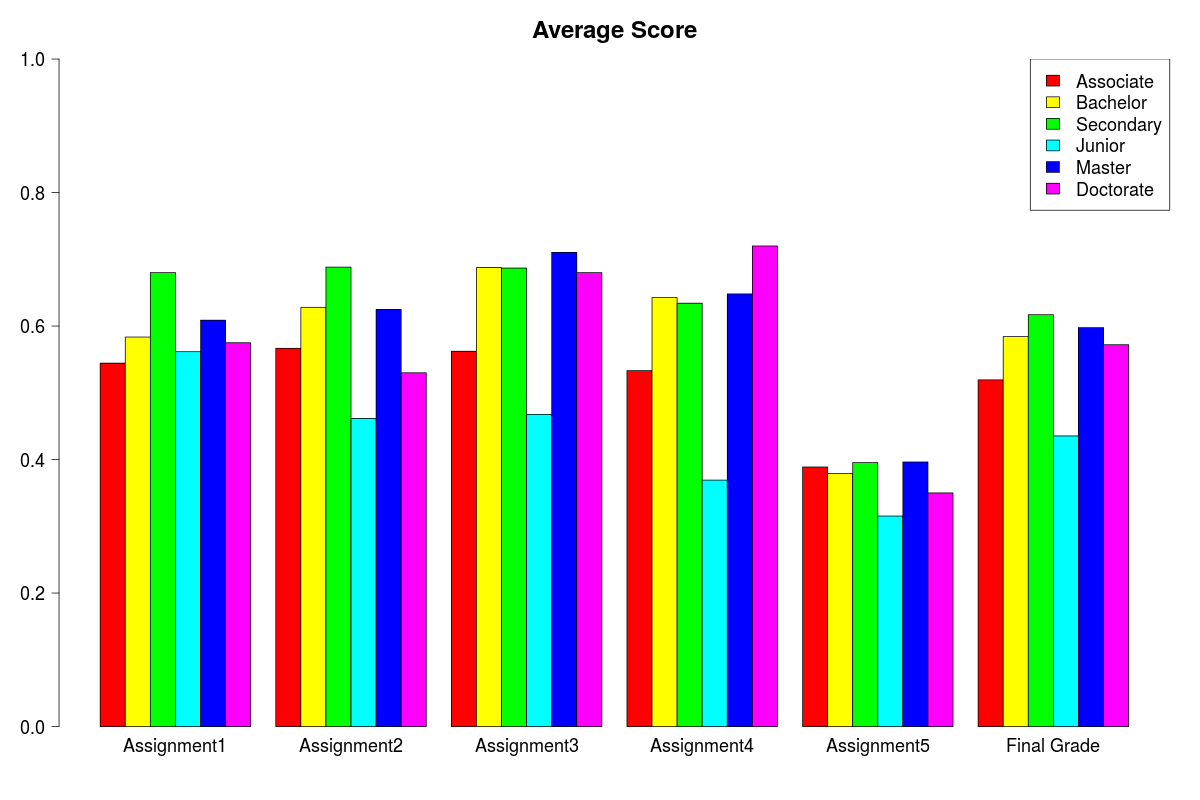
The data indicate that obtaining higher degrees do not necessarily make people smarter news consumers.
This gives the researchers the dataset that can be examined in a wide variety of ways to explore whether there is a correlation among different variables. For example, the relationships between two of the followings can be examined.
Selected demographic variables
News literacy skills (assessed by the assignment results)
Frequency of forum posts
Forum engagements
Video playback patterns
Click-through behaviors
2. Control group recruitment? A/B testing? Double-Blind test? Not so difficult.
The online platform makes it possible and easy to test different instructional designs, a variety of video-based communications and other pedagogical methods to teach news literacy.
For example, a researcher could produce two or three different instructional video clips with the same script – one with the instructor talking with his/her face shown, one with an avatar replacing the instructor’s face, and one with a professional TV talent taking the role of the instructor.
The three clips can be randomly assigned to different students. Later, the effectiveness of each clip could be measured by the results of quizzes that follow immediately after the video. Such A/B testing normally won’t work in a lab setting as standardizing the test-takers’ individual abilities would be next to impossible, but the whopping sample size that a MOOC can provide could possibly alleviate such concerns greatly.
With the same method, two different news articles can be given to the students with only one word changed. It would be interesting to see if the choice of one word over the other would affect the ways students detect and evaluate media biases. The possibilities of using the online platform for both teaching and research at the same time are limitless here.
3. Who is communicating with whom? Qualitative insights into the minds of students and their learning behaviors.
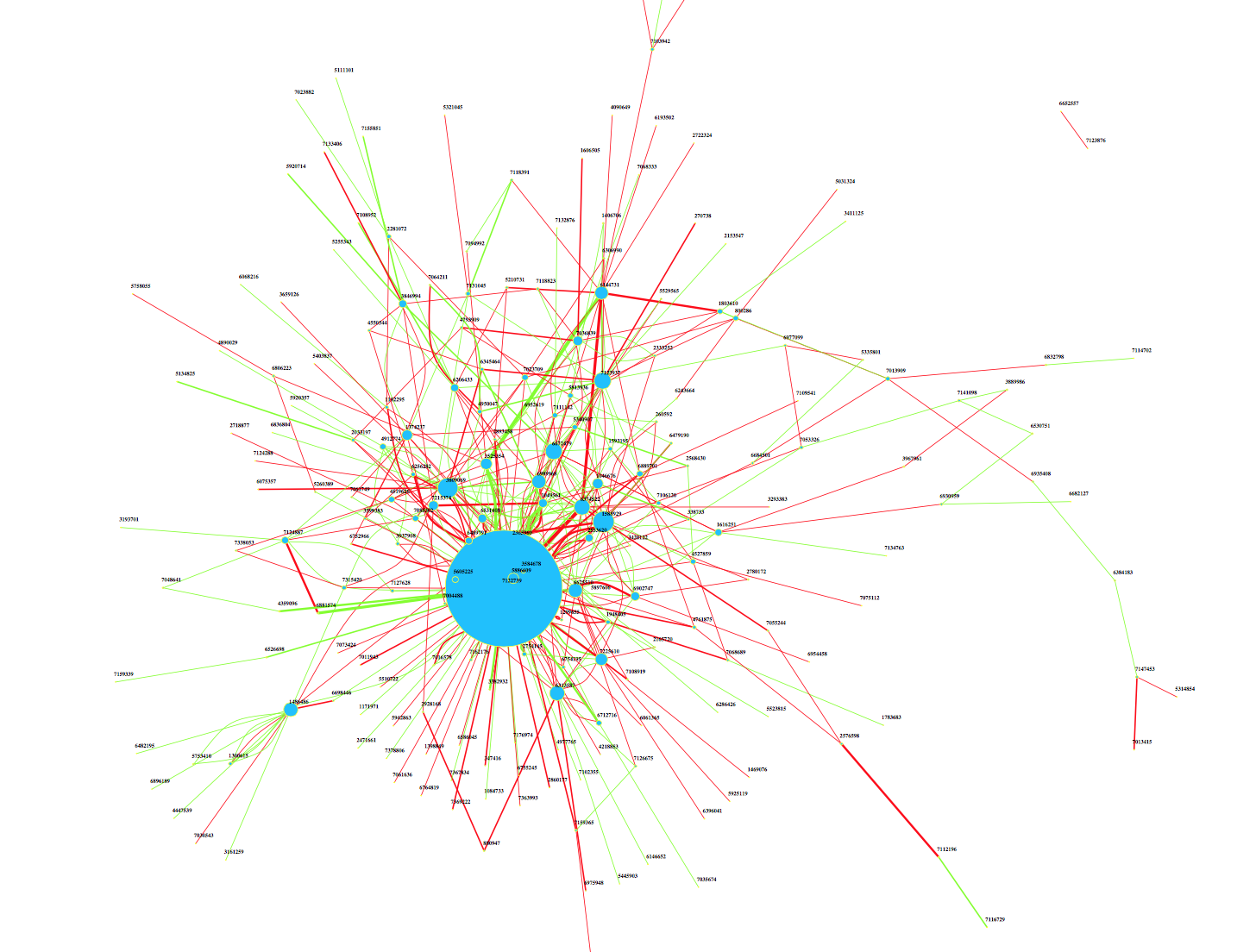
Every single communication can be mapped on MOOC.
The written communications among the students can be tracked down, mapped and combined with other variables, which could form a foundation for qualitative research.
The dataset allows researchers to see how each student engages with one another through peer-reviewed assessments and forum discussions easily.
Once certain patterns are identified, researchers can delve into the content of their written communication.
Say, for example, let’s suppose there are two clusters of engagements among high news literacy skill students (group A) and low news literacy skill students (group B) that were organically formed. If the data shows that they (the group A and B) are not communicating with each other, we can qualitatively analyze their digital conversations and possibly distinguish some key elements that might tell us why certain instruction works for some students and not others.
4. What works? What doesn’t? Improving our teaching.
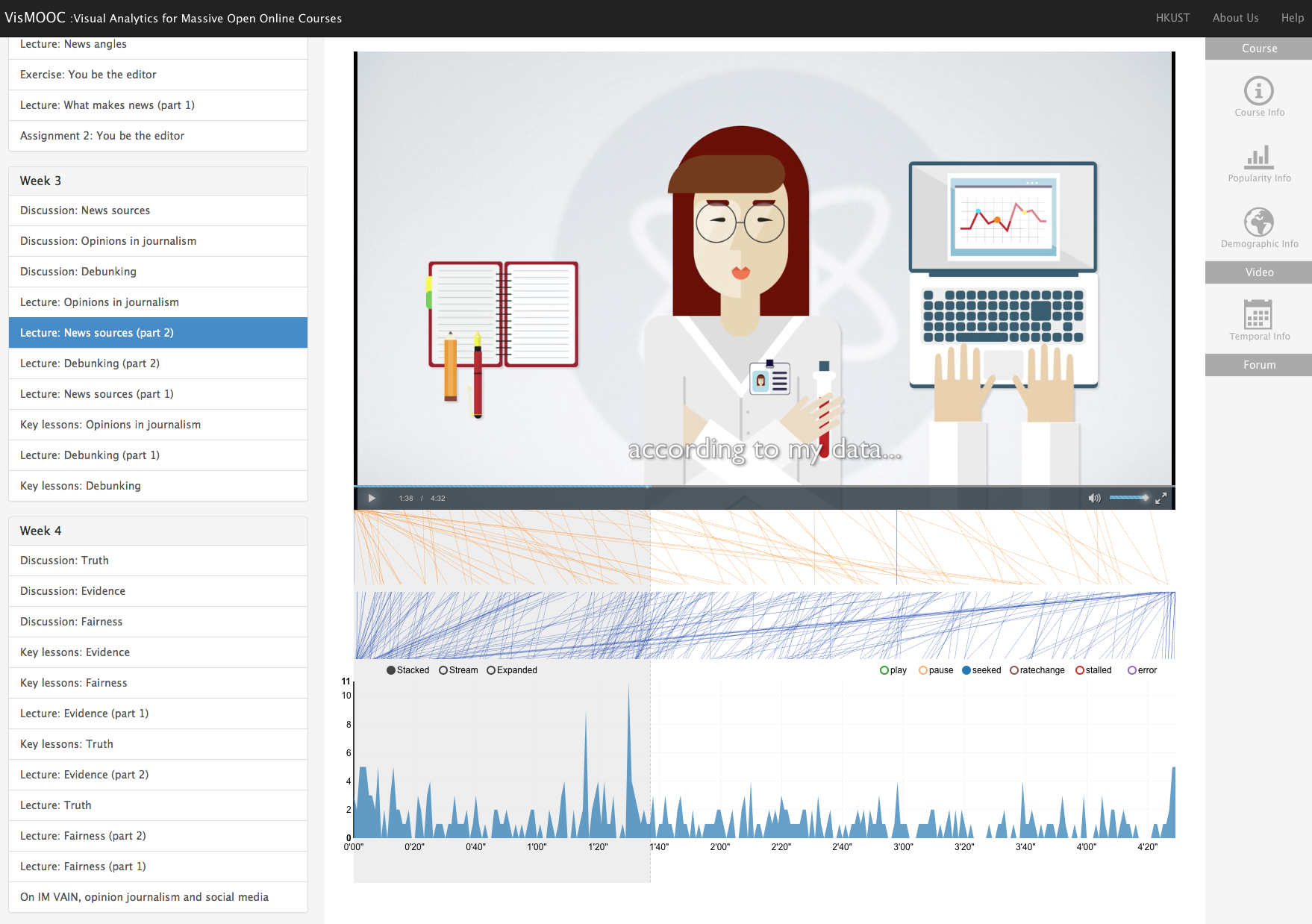
The detailed video playback data reveals many things. For instance, the learning analytics system developed at Hong Kong University of Science and Technology called VisMOOC can let us visually see each video clip’s “forward seeks” and “backward seeks.”
VisMOOC visualizes video playback data.
We could see the exact points where students paused, fast-forwarded and rewound the clip, which indicates not only how students interacted with the video lectures but also what visual cues disappeared too hastily for them (pause), which parts seemed to have been considered redundant or unnecessary (fast-forward or “forward seeks”), and what concepts and explanations were difficult to understand (rewind or “backward seeks”).
The click through data and other web analytics data also reveal many other factors that would inform us of the students’ learning: say, for instance, which reading assignments students tried to read (click), how much time students spent to complete different exercises and assignments, what time/day they accessed the teaching materials and so much more, all of which could provide valuable information for us to improve our teaching.
Possibilities endless
The above four ideas are only a fraction of what we can do with the online-based news literacy education and research. By taking advantage of the detailed behavioral data with a large sample size, researchers can now track down, aggregate, and investigate the varying patterns of news literacy skill acquisition. The implications and possible future directions of internet-based teaching and research are, I dare to say it, endless.
Ultimately, this kind of research could evolve into a computer modeling that pinpoints specific variables as predictors. We could measure the effectiveness of educational intervention in the field of news and media literacy and improve our teaching strategies accordingly, as our goals are to nurture the future generation of discerning media consumers who also produce and distribute content.
In today’s technologically interconnected societies, I believe the computer modeling would give great insight into the design of effective online pedagogy while presenting opportunities for news literacy scholars to test a multitude of pedagogical designs, teaching methods and research hypotheses in a large scale.
To provide new University staff with useful information about the wide range of services offered by Information Technology Services (ITS), a series of orientation activities will be conducted between late August and mid-September. All new University members are welcome to join.
1. Use of AV/IT Equipment in Central Classrooms
To familiarize themselves with the classroom facility, new teachers and class instructors are encouraged to join one of the training sessions on the use of AV/IT equipment in central classrooms. Through this session, they will be able to learn how to use the control panel, visualizer and other AV/IT equipment in the centrally timetabled classrooms.
The seminar on “Introduction to Information Technology Services (ITS)” gives an introduction of the comprehensive range of central IT and network services offered by ITS.
On top of the introductory session, the following parallel sessions will be arranged on the same dates. They are-
About the University’s Research Support Computing Environment and the HPC/HTC Facilities
Introduction to IP Telephony and Video Conferencing Services
Chi Wah Learning Commons guided tour
Another series of training on “Introduction to Moodle Learning Management System and Panopto Lecture Capture System” specifically for new colleagues will also be conducted.
An exhibition booth will be arranged in the first two weeks of the first semester (September 1 – 11, 2015) with display boards showing the core IT Services, in particular the support for teaching and learning and research with University.
Date: September 1, 2015 (12:00 noon) to September 11, 2015 (5:00 pm)
Venue: G/F, Chi Wah Learning Commons, Central Podium Level, Centennial Campus
Veronica Yick
User Services
Information Technology Services