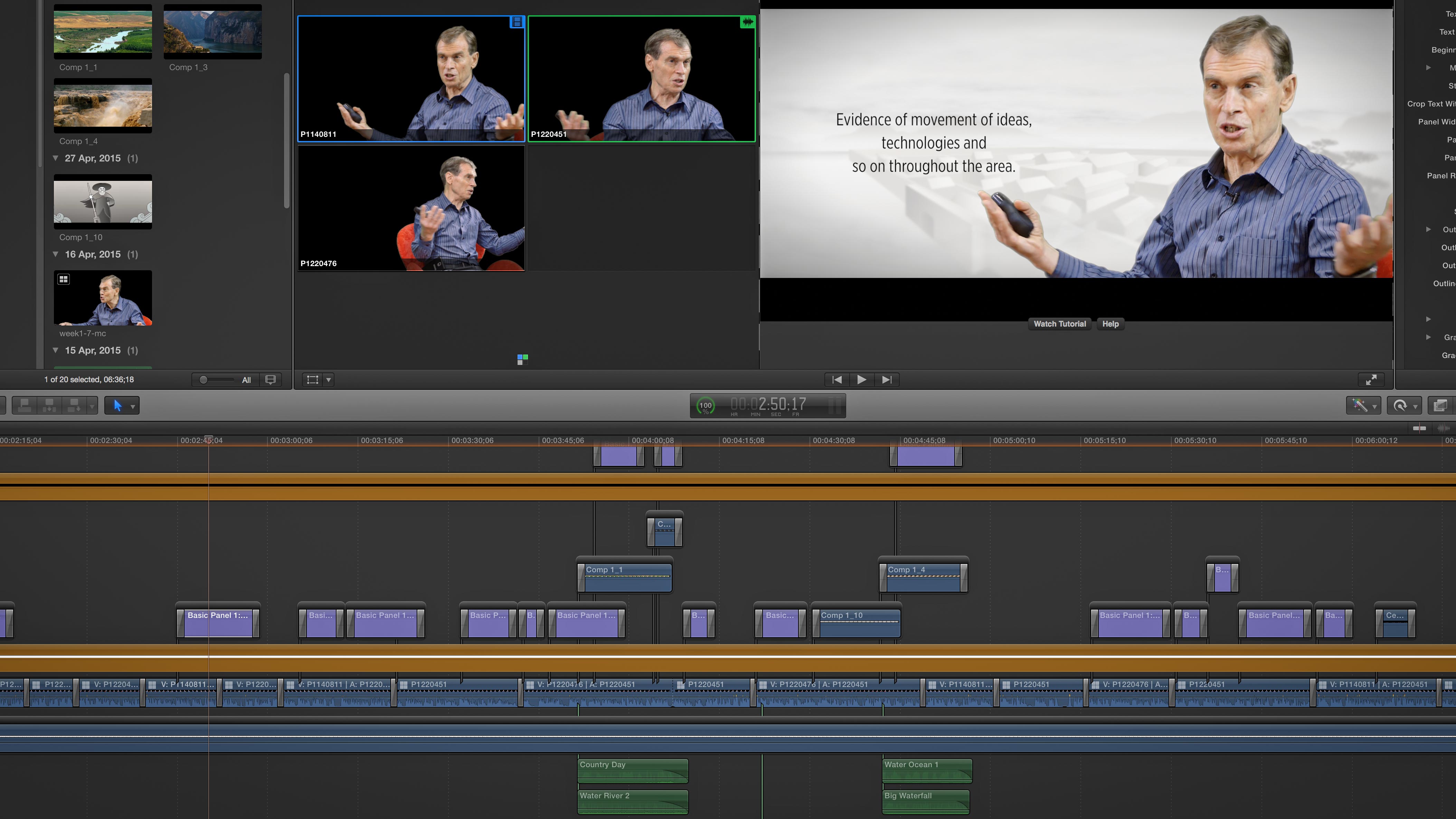
Philosophy can be a daunting subject to teach, as it often involves the explanation of complex and abstract ideas, and encouraging students to think creatively and independently. The challenge becomes more pronounced in the context of online teaching, where students learn remotely and independently in front of their own computers. How do you engage the students and maintain their attention span, while doing justice to the intellectual depth of the subject? Such was the challenge we faced when we produced HKU03x Humanity and Nature in Chinese Thought.
Course Instructor Professor Chad Hansen is a brilliant philosophy teacher. His lectures are always intellectually challenging and interesting at the same time. So how did we turn his course into a MOOC? At first we tried the traditional method of asking the teacher to speak directly into a teleprompter, as if addressing the viewers himself. The result was not bad, but that could not capture the dynamic and engaging character that his lectures are well known for – something was missing.
So the production team tried a new and risky method – we put Professor Hansen in a small classroom setting and surrounded him with real students and cameras. We shot it like a mini-concert in order to capture his signature performance. We also spent weeks talking to Professor Hansen and the course team learning about the subject matter, and then got our graphic designer to design some interesting and relevant visuals to present those abstract philosophy concepts. And the result was great.
This balance between education and entertainment is a hard one to strike. And we hope, with this new attempt, we will be able to make the teaching of abstract subjects as informative, enlightening, and enjoyable as possible. And we cordially invite you to take part in this.
Moodle has been in place to support the University’s electronic teaching and learning since 2011. It is a good practice to offload the old courses to the Moodle Archive System to release the loading and storage on the production server for better performance.
ITS will move all Moodle courses of the academic year 2013-14 (i.e. course code ended with “_2013”) from the production Moodle system to the Archive System in the middle of July 2015. The Moodle courses being archived will be frozen on 3 July 2015 for moving.
After the move, students, teachers and course administrators still have the “Read-only” access to these archived courses via the “My eLearning” tab of HKU Portal. “Read-only” means that users could not change course contents nor make any submissions to assignments or forums. More details about the Archive System are shown at the FAQ section of the Moodle Resources website (click here to visit).
If there are good reasons that your courses should not be moved to the Archive System this July, please send us email with detailed information to eLearningTeam@hku.hk on or before 30 June 2015. Thank you for your attention.
Best Regards,
CP Lau
eLearning Team
Information Technology Services
Speaker: Dr. Una-May O’Reilly, Principal Research Scientist, AnyScale Learning For All Group, MIT Computer Science and Artificial Intelligence Laboratory Date : 16 June, 2015 (Tuesday) Time : 12:45pm – 2:00pm Venue : Room 321, Run Run Shaw Building
Abstract:
Understanding why students stopout will help in understanding how students learn in Massive Open Online Courses (MOOCs). In this seminar, Dr. Una-May O’Reilly will describe how she and her research group build accurate predictive models of MOOC student stopout via a scalable, prediction methodology, end to end, from raw source data to model analysis. They attempted to predict stopout for the Fall 2012 offering of MIT’s 6.002x.
This involved the meticulous and crowd-sourced engineering of over 25 predictive features extracted for thousands of students, the creation of temporal and non-temporal data representations for use in predictive modeling, the derivation of over 10 thousand models with a variety of state-of-the-art machine learning techniques and the analysis of feature importance by examining over 70,000 models. They found that stopout prediction is a tractable problem. Their models achieved an AUC (receiver operating characteristic area-under-the-curve) as high as 0.95 (and generally 0.88) when predicting one week in advance. Even with more difficult prediction problems, such as predicting stop out at the end of the course with only one weeks’ data, the models attained AUCs of ~0.7.
About the Speakers:
Dr. Una-May O’Reilly (http://people.csail.mit.edu/unamay/) leads the AnyScale Learning For All (ALFA) group (http://groups.csail.mit.edu/ALFA) at Massachusetts Institute of Technology Computer Science and Artificial Intelligence Laboratory. ALFA focuses on scalable machine learning, evolutionary algorithms, and frameworks for knowledge mining, prediction and analytics. She received the EvoStar Award for Outstanding Achievements in Evolutionary Computation in Europe in 2013 and serves as Vice-Chair of ACM Special Interest Group for Genetic and Evolutionary Computation (SIGEVO).
Message from Centre for Information Technology in Education within the Faculty of Education
CITE Seminar Series 2015/2016
CITE & Faculty of Education Joint Seminar – Measuring attitudes and dispositions of digital age learners
Date: 3 June 2015 (Wednesday)
Time: 12:45 pm – 2:00 pm
Venue: Room 101, 1/F., Runme Shaw Building, The University of Hong Kong
Speaker: Dr. Gerald Knezek, Regents Professor of Learning Technologies, University of North Texas, USA
Chair: Prof. Nancy Law, Professor, Faculty of Education, The University of Hong Kong
About the Seminar
Attitudes and dispositions are affective (feeling) components of human perception, rather than cognitive (thinking) or behavioral (taking action) human domains. They are important because they influence the acceptance and use of technologies as well the motivation to learn. We bother with procedures to ensure accurate assessment of attitudes and dispositions ultimately for accountability of impact. A government, school system, or other publicly funded entity wishes to know what is being accomplished with the funds allocated. Attitudes can be changed relatively quickly while changing a student’s general level of achievement takes much longer. Over time positive attitudinal changes lead to higher achievement. These concepts are central to digital age learning.
Research has shown strong links between pupils’ attitudes and the effect on information technology use and learning. Unfortunately, technology changes very fast, so studies must keep up with the current times and also look to the future. In just one decade the emphasis in many countries has shifted from having students perform well on standardized achievement tests to “happiness indices” and nurturing interest in science, technology, engineering, an math (STEM) from an early age. We must anticipate the day when major studies will focus on attitudes and dispositions related to transformations “in the cloud” or in social networking environments. Already emerging are studies of attitudes and dispositions toward mobile devices for informal learning and toward 1-to-1 devices in formal education. There is much work that remains to be done in these areas. This seminar will focus on instruments and techniques for assessing attitudes and disposition toward IT in education, and introduce models for assessing impact on outcomes important to society
About the Speaker
Dr. Knezek’s research interests include measuring attitudes and dispositions toward information technology, developing and testing formal models of technology integration, developing practical research designs, and refining scaling methods and techniques. He is Director of the Institute for the Integration of Technology into Teaching & Learning (IITTL) at UNT and immediate Past President of the Society for Information Technology & Teacher Education (SITE). He was a Founder of the American Educational Research Association Special Interest Group on Technology as an Agent of Change in Teaching and Learning (TACTL SIG). He is Lead Principal Investigator for a U.S. National Science Foundation (NSF) Innovative Technologies project Going Green! Middle Schoolers Out to Save the World (NSF #1312168), a four-year scale-up expanding five years of initial funding (MSOSW, NSF #0833706) aimed at enhancing middle school student interest in STEM content and careers. He is Co-Principal Investigator for an NSF-funded Digital Fabrication project conducted at UNT in collaboration with the University of Virginia and Cornell University (Fab@School, NSF #1030865) featuring the development of engineering design skills at the upper elementary school level. He was previously Co-Principal Investigator for a U.S. Fund for Improvement for Post-Secondary Education project titled simMentoring (#P116B060398, 2007-2010) as well as an NSF Research in Disabilities grant featuring the placement of virtual students with disabilities in dynamic, online simulator or teachers (2009-11). His most recent funding in the strand of games and simulations for teaching and learning was serving as Co-PI on the umbrella grant and lead PI on the local UNT award from Gates/EDUCAUSE to expand the user base of simSchool worldwide to 10,000.
Organized by e-learning Pedagogical Support Unit, CETL
Speaker: Professor Curtis Bonk (Professor of Instructional Systems Technology, Indiana University) Date : 5 June, 2015 (Friday) Time : 12:45pm – 2:00pm Venue : Room 321, Run Run Shaw Building (registration is capped at 60 due to room capacity)
During the past few years, learning has become increasingly collaborative, global, mobile, modifiable, open, online, blended, massive, visually-based, hands-on, ubiquitous, instantaneous, and personal. This is the age of Education 3.0 where learning is about playful and highly engaged design where learner creation of products is the new norm, often with the use of digital media. We humans tinker, invent, and express ourselves, and we find meaning in our playful pursuits. Fortunately, we are living in an age of educational resource abundance where passion, play, purpose, and freedom to learn take precedence over the more mind-numbing traditional information reception models of learning.
Instructors and experts are most effective as curators, counselors, consultants, concierges, and cultivators of student learning. These are the new instructional “C” words; gone are words like learning coercion, credit management, and fixed notions of correctness. Education 3.0 instructors are the ones who foster students’ autonomy and self-directed learning pursuits while, simultaneously, offering insightful guides and timely scaffolds where and when appropriate.
Attend this talk and find out how Education 3.0 will impact instructors and students, and how, in turn, we all can significantly impact it.
About the Speakers:
Dr. Curtis Bonk is Professor of Instructional Systems Technology at Indiana University. A prolific author and internationally known speaker, he has published more than 300 articles and books on e-learning and has given more than 1,200 talks on many topics related to learning technologies and human learning.
Dr. Bonk received the CyberStar Award from the Indiana Information Technology Association, the Most Outstanding Achievement Award from the US Distance Learning Association, and the Most Innovative Teaching in a Distance Education Program Award from the State of Indiana. From 2012 to 2015, Bonk was named annually by Education Next and listed in Education Week among the top contributors to the public debate about education from more than 20,000 university-based academics. In 2014, he also was named the recipient of the Mildred B. and Charles A. Wedemeyer Award for Outstanding Practitioner in Distance Education.
Abstract This lecture will discuss how Berkeley has been performing relative to its MOOC goals: what has worked well, what they perhaps should have done differently or what they wish they were doing better, what challenges they face next, how MOOCs have affected classroom learning and teaching, and what their future might be at Berkeley. They continue to believe that the new momentum in online education is a strategic and permanent change for universities, even if that change ultimately takes a very different form than what the original MOOC creators envisioned.
Date: May 26, 2015 (Tuesday) Time: 6:30 p.m. – 8:00 p.m. Venue: Lecture Theatre A, Chow Yei Ching Building, The University of Hong Kong,
Pokfulam Road, Hong Kong Speaker: Professor Armando Fox Charge: Free registration
About the Speaker
Armando Fox is a Professor in Berkeley’s Electrical Engineering & Computer Sciences Department and the Faculty Advisor to the UC Berkeley MOOCLab. With his colleague David Patterson, he co-designed and co-taught Berkeley’s first Massive Open Online Course on “Engineering Software as a Service”, offered through edX, through which over 10,000 students in over 120 countries have earned certificates of completion. He also serves on edX’s Technical Advisory Committee, helping to set the technical direction of their open MOOC platform. His current research in online education includes automatic grading of students’ computer programs for style and improving engagement and learning outcomes in MOOCs.
Those interested in attending are requested to register online before noon, May 22, 2015.
For inquiries, please contact us by email at enggfac@hkucc.hku.hk or by phone at 2859 2803.
Dr. Beth Simon Principal Teaching and Learning Specialist on the Course Success team, Coursera
Faculty member of UC San Diego Jacobs School of Engineering
Venue & Time: CPD 2.75, 20 May 2015 12:45pm – 2:00pm
Why create a MOOC in a science or engineering topic – and once you’ve decided to take the plunge, how do you set your course up to be successful on Coursera? Dr. Beth Simon will share her recommendations based on her experience both as a Professor of Computer Science and Engineering and as Coursera’s Principal Teaching and Learning Specialist. In this workshop, we will discuss faculty experiences of creating courses in science and engineering subjects on Coursera, including faculty goals and motivations as well as practical advice and best practices for course design and implementation.
About the speaker
Dr. Beth Simon is the Principal Teaching and Learning Specialist on the Course Success team of Coursera. Beth is also a professor of Computer Science and Engineering at UC San Diego where she specialized in teaching large classes and improving learning with student-centered learning environments and educational technology. She also worked with faculty implementing hybrid/flipped classes using Peer Instruction as Director of UCSD’s Center for Teaching Development. In 2007-2008, Beth served as Science Teaching and Learning Fellow with Nobel Laureate Carl Wieman’s Science Education Initiative at the University of British Columbia.
Dr. Benson YEH, National Taiwan University
Venue & Time: CPD 3.04, 18 May 2015 12:30pm – 2:00pm
How can we keep students engaged in class? How can we make our students motivated to learn? These are the most challenging questions for teachers nowadays. Dr. Yeh developed a series of Peer-to-Peer teaching and learning schemes following his unique teaching teaching philosophy: “For the student! By the student! Of the student!”. In this talk, Dr. Yeh will explain how his schemes work and show the amazing results from his students’ course work.
Seminar: Gamification in E-learning
Professor Toru IIYOSHI, Kyoto University
Venue & Time: CPD 3.04, 19 May 2015 12:30pm – 2:00pm
Although gamification in education is not a new idea, the evolution of increasingly media rich, open, social, and intelligent learning tools, environments, and educational approaches—enabled and enhanced by information and communications technology (ICT)—is rapidly transforming the landscape of learning and teaching. This seminar delves into some of the critical pedagogical, cognitive, motivational, and emotional aspects of technology-supported gamification in education by reviewing and examining the past and present practice as well as foreseeing some of the future possibilities that will help further advance individual and collective capacity development and education systems in the 21st century society.
Public Seminar: Flipping the classroom – A new way to better learning
Dr. Benson YEH, National Taiwan University
Venue & Time: CPD 3.04, 19 May 2015 5:30pm – 7:00pm
Flipped classroom has attracted attention in recent years. However, how to conduct flipped classroom effectively remains a question to many teachers. How should a teacher motivate students to watch videos in advance? How can a teacher teach well without giving any homework? There are many doubts about flipped classroom for teachers without the experience.
Dr. Yeh is one of the most renowned teaching innovators in Taiwan. He developed a total solution “BTS Flipping” for flipped classroom. He has been invited to give more than 200 talks last year on “BTS Flipping”. Dr. Yeh’s talks have motivated tens of thousands of teachers in Taiwan to start flipping their classes.
About Dr. Benson YEH, National Taiwan University
Dr. Yeh has pioneered many educational experiments and designs:
He is the first to win the Overall Award and E-Learning Award in Wharton-QS 2014 Stars Awards: Reimagine Education, the “Oscars” of innovations in higher education.
He is the first to teach a MOOC course in Chinese with 48,000+ students.
He is the first in the world to design a MOOC-based multi-student social game to enhance the learning experience of MOOC students.
He is the first to design various experiential learning schemes that enable college students to be graded by elementary school students on their presentation skills.
He is the first to create and promote the style of designing mathematical problems with creative literary writing.
Since 2010, Dr. Yeh has been the strong advocator of his teaching philosophy: “For the students, By the students, Of the students”. It states that students can be motivated to learn if teachers can share more responsibility with them (e.g., by letting students design their own homework problems. Dr. Yeh’s speeches have motivated many teachers to start thinking differently in teaching. His new book on education, “Teach for the future” has been one of the bestsellers in Taiwan.
About Professor Toru IIYOSHI, Kyoto University
Toru Iiyoshi is Director and a professor at the Center for the Promotion of Excellence in Higher Education (CPEHE) of Kyoto University where he also serves as Deputy Vice President for Education. Previously, he was a senior scholar and Director of the Knowledge Media Laboratory at the Carnegie Foundation for the Advancement of Teaching, a visiting professor at the Graduate School of Interdisciplinary Information Studies of the University of Tokyo, and Senior Strategist in the Office of Educational Innovation and Technology at Massachusetts Institute of Technology.
Prof. Iiyoshi’s current areas of research and development include educational innovation and technology, open education, technology-enhanced scholarship of teaching and learning, and future of higher education systems. He works with various national and international initiatives, projects, and organizations in an advisory role to provide vision and leadership in the development and distribution of innovative educational technology. Prof. Iiyoshi is the co-editor of the Carnegie Foundation book, “Opening Up Education: The Collective Advancement of Education through Open Technology, Open Content, and Open Knowledge” (MIT Press, 2008).