About this course
How do electrical engineers find out all the currents and voltages in a network of connected components? How do civil engineers calculate the materials necessary to construct a curved dome over a new sports arena? How do space flight engineers launch an exploratory probe?
If questions like these pique your interest, this course is for you!
Calculus with differential equations is the universal language of engineers. In this 7-week course, “Engineering Calculus and Differential Equations,” we will introduce fundamental concepts of single-variable calculus and ordinary differential equations. We’ll explore their applications in different engineering fields. In particular, you will learn how to apply mathematical skills to model and solve real engineering problems.
This course will enable you to develop a more profound understanding of engineering concepts and enhance your skills in solving engineering problems. In other words, you will be able to construct relatively simple models of change and deduce their consequences. By studying these, you will learn how to monitor and even control a given system to do what you want it to do.
Techniques widely used in engineering will be illustrated; such as Laplace transform for solving problems in vibrations and signal processing. We have designed animations and interactive visualizations to supplement complex mathematical theories and facilitate understanding of the dynamic nature of topics involving calculus.
Whatever you know and wherever you are we invite you to join us on a journey to consider how the local and the global intersect to make Hong Kong cinema an integral part of popular culture around the world as well as a leading force in the development of world cinematic art.
Develop your critical and historical thinking skills through analyzing the interconnected relationship between the global scene and local lives in HK films;
Broaden your perspectives on identity issues through finding the familiar in the foreign in Hong Kong cinema;
Deepen your perspective on the impact of globalization on your own society through analyzing Hong Kong cinema.
課程精髓
通過分析香港電影業的本地市場與國際舞臺之間的關係,培養您的批判和歷史思維能力;
在香港電影中不熟識的場景尋找熟識的細節,從而拓展您對身份問題的了解;
通過分析香港電影業,讓您更明白全球化對社會的影響。
The course was awarded the 2017 MOOCr Awards – Bronze Award (Course Management and Promotion) in the 4th Greater China MOOC Symposium.
In our last post, we covered feedback practices designed by 3 teachers with the aim of enhancing students’ learning through feedback. This post will dive into the sharing of 6 other teachers.
Loop Learning Effectively
Dr. Charlene Ho combats the lack of feedback loop in her classes of 100-150 students by involving students in the process of providing feedback. For projects, she puts students into groups where they have to brainstorm ideas collectively, before going into a short consultation with herself on their ideas. Following that, each individual student produces their own draft of the project, which is then peer reviewed by other students according to the assessment rubrics. Having received comments from peers, the student reflects on their work, further revises the project and submits the final product. This entire feedback looping process takes place on Moodle.
History as Feedback
Professor David Pomfret integrates both formal and informal feedback in his history class. Based on in-class written responses to related questions by students, Professor Pomfret engages his students in historical scenario debates, where each student takes the role of a historical figure. As each student has the objective of winning the debate on behalf of their characters, they are motivated to read the course materials and prepare for class. Students’ debate performances are carefully observed and evaluated by teaching assistants, who walk around the classroom providing guidance and feedback. In addition, students from different groups or scenarios get to comment on each others’ strengths and weaknesses in debating. The debates are concluded by students voting for the best scenario debate, after which the teacher explains how the winning scenario deviates from the actual event that took place in history.
In order to deepen the feedback loop in the course and further engage his students, Professor Pomfret encourages his students to play a scenario based history video game, where students answer multiple choice questions and receive instant feedback on the choices made. Professor Pomfret plans to introduce a new function to the game where students get feedback on the pathways they choose.
Professor David Pomfret was responding to questions raised by participants.
Time-saving Technique: Audio Feedback
Rethinking Feedback – Using Audio Feedforward to Help Students Improve Their Written Work
Ms. Tanya Kempston shares a sustainable and dialogic practice of providing students with short audio recorded feedback, that helps lighten the burden of writing or typing comments to hundreds of student works. Ms. Kempston feels an urgent need for feedback in higher education to evolve, as university class sizes have doubled and or even tripled. In order to cater for larger classes, she looks into the possibility of more efficient forms of feedback other than written. She resolves to audio using Voice Memos in conjunction with assessment rubrics, a more efficient way to provide audio feedforward. Annotations can accompany the audio commentary on the margins of a student’s work to avoid repetition. Voice Memos are concise and no longer than 3 minutes, so that students will not see listening to the audio commentary as a burden. Ms. Kempston emphasizes that audio feedback offers plenty of advantages such as time-efficiency, accountability and permanency. She also adds that students feel more connected with the teacher by listening to the audio feedback.
Using Audio Feedback and Whole Class Feedback to Help Students Develop Their Writing
Mr. Philip Smyth further elaborates on the efficiency brought by audio feedback which he also uses to tackle heavy workload of giving feedback. He calculates the time he saves with audio feedback in the picture below:
[Image credit: Mr. Philip Smyth.]
He uses the audio commentary tool in Turnitin that allows a recording of 3-minute oral feedback along with short textual notes on each student’s assignment. On average, he managed to decrease the amount of time spent on a single assignment down to 10 minutes. In addition, Mr. Smyth also implements whole class feedback in his course, and he points out that the overall time he spent on giving whole class feedback and audio feedback is still less than writing individual feedback.
However, Mr. Smyth also acknowledges the disadvantages of audio feedback on Turnitin. For instance, if a student wants to go back to listen to a specific piece of advice or suggestion in the audio recording, he or she may have to take more time locating it in the track. Another issue is related to the fact that Turnitin currently does not keep audio comments permanently which makes it difficult for students to compare previous feedback with a new one affecting the learning progress.
Using Three Layers of Feedback to Increase Taught Postgraduates’ Engagement with Feedback
Using a theoretical framework on students’ engagement with feedback, Dr. Jessica To tries to explicate why students increase or decrease feedback engagement in the taught postgraduate course she teaches:
More often than not, part-time students in the course tend to avoid collecting their final assignments. However, even if they collect their marked assignments, they often struggle to interpret the feedback and the grade given. Taking into account the evening setup of face-to-face classes that leaves insufficient time to engage in dialogic feedback, Dr. To proposes a feedback strategy that requires students to provide audio-recorded self-evaluation for their own assignments via instant messaging apps, such as WhatsApp or WeChat, after being peer reviewed by 3 other students on Moodle. She also provides audio feedback to the student via instant messenger apps to comment on their accuracy of self-assessment, and give suggestions for improvement. As a result, students enhance learning agency in the “reversed” feedback process while allowing more time to reflect on peer and teacher feedback due to the asynchronous nature of the strategy. Furthermore, Dr. To emphasizes this practice helps develop students’ evaluative judgement, and enable them to transfer this ability to self-assessment work. On the other hand, this also stimulates students’ self reflection by obtaining constructive feedback from peers.
Practicing Feedback
Mr. Mathew Pryor uses feedback to a) review an assignment, b) as a way of affirming learning, c) to instruct or provide additional information, d) to comment or provocate and e) to develop higher order thinking. Mr. Pryor believes feedback should have a variety of forms and characteristics to enhance students’ understanding and learning, which he incorporates into his architectural studio classroom setup. In this classroom setting, instructing is interchangeable with giving feedback, as teaching assistants walk around observing and commenting on students’ works throughout the lesson. Sometimes students’ designs are reviewed by external professionals in order to gain as objective perspectives. Feedback is also provided outside the studio right at the architectural sites being studied. Moreover, students also get to learn from reviews by commenting on each others’ designs during gallery review sessions. All these elements of the feedback in Mr. Pryor’s class shapes it into a multi-directional communication.
Mr. Mathew Pryor introduced feedback practice in his courses.
To sum up the symposium, Professor David Carless draws a special attention to two issues related to feedback practices in higher education: scalability and literacy. Feedback should be more work for students than teachers, and scalability issues faced by the presenters in the symposium should be effectively tackled. It is equally important to put forth the idea that improves the attitudes towards “seeking feedback, making sense of it, processing it and feeding into work”.
Follow #HKUFeedback on Twitter to check out more event details! Don’t hesitate to Contact us if you are interested in collaborating with us to enhance teaching and learning at the University!
We all acknowledge the importance of feedback – a crucial element in learning, that it facilitates one’s understanding of their own work, prompts reflection and provides pointers for further improvement. Despite the consensus of feedback being beneficial, an important question to ask is whether what we do is adequate and effective. What constitutes effective feedback, and how can we choose the right feedback to suit different contexts? In the Feedback for Learning Symposium, teachers from different faculties share their insights and experience in designing feedback mechanisms to improve students’ learning.
What is Feedback?
Ms Nicole Tavares sums up the characteristics of good feedback. [Image credit: Ms Nicole Tavares.]
Feedback can take many different forms, but the crux of feedback is to facilitate students’ learning capabilities, strategies and development, as emphasized by Professor David Carless of the Faculty of Education. In the above picture, Ms Nicole Tavares, also of the Faculty of Education, sums up the characteristics of good feedback.
Ultimately, for feedback to make an impact, it has to be accountable, advancing, and most importantly, actionable. As explicated by Professor Ricky Kwok, Associate-Vice President of HKU (Teaching and Learning), feedback should be accountable so that both teachers and students can measure its effectiveness. Furthermore, feedback should enable students to take their learning progress to the next level. Last but not least, feedback by a teacher is only actionable when the receiving student is able to take direct actions based on it, making it practical and impactful.
What are students expecting?
Authentic assessment practices have been adopted across different disciplines in HKU, some of which are enabled by technology. Here are some examples:
Feedback on a draft/proposal by a student;
Short face-to-face consultation with the teacher to elaborate and comprehend the initial feedback;
Final feedback on an assignment submitted together with a mark or grade.
In addition, they also highlighted that feedback is of greater value if it were provided when the student is still in the process of doing an assignment, in form of further guiding prompts, directions or even motivation from the teacher, which are instrumental in helping them overcome the challenges in learning.
Professor David Carless and the Student Panel.
The students also gave examples of weak or ineffective feedback that influence student’s learning:
Highlighting or underlining with no additional textual explanations in assignments
Indication of citation mistakes without suggesting ways of improvement
No explanation for correct and wrong answers in online quizzes
In general, students find simply knowing “what” is right or wrong with their work inadequate, and push for the reasons “why” and methods of “how” their work can be improved under their teachers’ guidance. In response to these issues raised by the students, Professor Carless says that feedback processes should be more practical and student-friendly in order to avoid misunderstandings between teachers and students.
Here are some examples of feedback practices designed and practised by teachers from different faculties at HKU, that you may find useful in your teaching:
Injecting Dialogue into Written Feedback Processes
Professor David Carless’ approach on actionable feedback on his students’ assignments is by asking students to write on the cover sheet of their assignment what kind of feedback they would like to receive, with given structure below:
“I would most like feedback on …”
“The strengths are …”, “The aspects for development are …”
“The previous feedback I have used to strengthen this assignment is …”
This dialogic writing helps finding out which aspects of feedback does a student want and needs help in. This also helps students reflect on the strengths and weaknesses of their submitted assignments. Furthermore, this reveals what kind of feedback that students received in the past helped improve the current assignment.
However, Professor Carless also points out the challenges he faced. For instance, more often than not students are not certain about what kind of feedback they need, and some are reluctant to reveal their own weaknesses. In response, Professor Carless helps students identify and explain them using assessment rubrics and criteria in detail.
Project Based Assessment and Feedback – Designing and Making Virtual Worlds
In a Common Core course that aims to get students from across various disciplines familiarized with the art and techniques of creating 3D artifacts, Dr. Nicol Pan employs many teaching assistants (TAs) who specialize in 3D technology and design, to help provide comprehensive and personalized feedback on students’ final projects. The main significance of the feedback practice used in this course is that students receive detailed and constructive feedback at each stage of the final project as shown in the below chart:
The four stages include idea generation, gather and draft, design and test, and make and morph. [Image credit: Dr. Nicol Pan.]
Dr. Pan agrees that feedback bridges communication between students and teachers, and this helps guiding students through every stage in a project. She also emphasizes the nature of feedback should be nurturing, but not hostile or makes students feel nervous.
Dialogic Use of Exit Slips to Promote Students’ Reflective Capacity
Dr. Kennedy Chan, who teaches pre-service teachers, proposes the use of exit slips at presentations to enhance students’ self-reflective skills, which help formulate their own teaching philosophies. The main concern in developing effective reflection among pre-service teachers is that they tend to produce self-speculations that are often too descriptive or superficial. Therefore, Dr. Kennedy Chan intended to a) provide timely and personalized written feedback on students’ reflections, b) expose them to multiple perspectives of their work, c) compare and contrast works to define a quality reflection and d) self-evaluate their learning progress. The process involved students writing a reflection after each session, which the teacher gives feedback on, and selecting the best one as an exemplar to discuss further in class. Student reflections are assessed based on a reflection scale.
The process is finalized after 12 sessions, where students select their top 3 reflections they have produced. They are also required to self-evaluate their own reflections based on the same reflection scale. Dr. Chan also motivates students to submit reflections on Moodle for peer feedback. He believes these practices can help foster students’ thinking and their sense making feedback effectively.
Full recording of the Symposium
Follow #HKUFeedback on Twitter to check out more event details! Don’t hesitate to Contact us if you are interested in collaborating with us to enhance teaching and learning at the University!
On HKU FinTech Day, Professor Douglas Arner from HKU Law Faculty announced the milestone of the Introduction to FinTech course and the HKU FinTech Professional Certificate comprising three interdisciplinary courses from three different faculties at HKU.
The first course, Introduction to FinTech was launched by the Faculty of Law in May 2018, and the upcoming two courses FinTech Ethics and Risks and Blockchain and FinTech are currently under development by the Faculty of Business and Economics and the Faculty of Engineering, respectively.
Introduction to FinTech MOOC Milestone
Professor Arner said it has been an exciting year for Introduction to FinTech MOOC. Today, the course has over 32,000 enrolled learners from 198 countries, which means there are learners from literally every country in the world. The course has a far and wide reach to learners, bridging the gaps in fundamental knowledge of FinTech for practitioners in financial services, legal and technology industries, students, and interested learners across various disciplines.
We anticipate that the two new MOOCs will continue to bring exciting news when released in 2019.
The short video of Professor Arner’s talk
Meet the Instructors of the Two New FinTech MOOCs Professor Arner tells the audience about the upcoming new MOOCs
Professor Douglas Arner introduced the two new MOOCs, FinTech Ethics and Risks and Blockchain and FinTech, and the chief course instructors of the two courses, Dr David Bishop and Dr David Lee from the Faculty of Business and Economics, and Dr SM Yiu from the Department of Computer Science of Faculty of Engineering, respectively.
FinTech Ethics and Risks MOOC
Dr David Bishop and Dr David Lee presented the official course trailer of the FinTech Ethics and Risks course and talked about the ideas behind putting together the world’s first course in FinTech ethics.
The Chief Instructors of FinTech Ethics and Risks MOOC, Dr David Bishop and Dr David Lee from the Faculty of Business and Economics.
David Bishop mentioned that some people perceive this MOOC as neither “Fin” nor “Tech” and stressed that “the way the course is going to be is to focus on the WHY; we have experts in the technology side and the legal side who will focus on the HOW, and explain the process, the nature and implementation of the FinTech technologies.”
David Bishop said that he and David Lee approached the course not from the standpoint of experts: “This course for us is as much an intellectual journey as it is for those who have come along this ride with us. We will correspond with and put ourselves in the room with the experts and try to ask them really hard questions.”
He supplemented that as far as he knew, “there isn’t a website or a course in the world that focuses on FinTech ethics. In this course, we will ask the tough questions to ensure that they have a proper sense of morality, ethics, legislation and enforcement in place, so that we are able to unleash those tools in the most efficient and effective way possible while simultaneously reaching the goals that we have.”
“The objective of the course is not to bring us to a specific set of knowledge but instead to carry a simultaneous journey together. Learners join us as we consider these tough questions that help shape our collective future,” said David Bishop.
The short video of Dr David Bishop’s talk about the new MOOC.
Blockchain and FinTech MOOC
Currently, Dr SM Yiu from the Department of Computer Science of the Faculty of Engineering is also driving efforts for putting together HKU’s first Blockchain and FinTech MOOC.
Dr SM Yiu gave the audience 9 questions to decide whether they should join HKU’s upcoming Blockchain and FinTech MOOC, which will be released later in 2019.
Let’s try these 9 questions now and see whether the MOOC is for you too!
Dr SM Yiu gave 9 questions to the audience to test their knowledge on blockchain
Q1: Blockchain = bitcoin (or cyber currencies)
Q2: A cyber currency exchange is necessary for blockchain to work correctly
Q3: What is the role of each cryptographic operation (e.g. hash)?
Q4: Why we want to chain the transactions together?
Q5: Who are miners and why we need miners?
Q6: Blockchain is very secure and can 100% protect your privacy?
Q7: Given an application, judge if it is best-fit for blockchain?
Q8: Do you know how bitcoin is used by criminals (the “evil” side)?
Q9: The differences between different blockchain platforms?
If you do not know the answers to any of the questions, you will find the answers in the 6 modules of the Blockchain and FinTech MOOC. You will also learn about blockchain design and architecture, industrial applications, as well as the new opportunities, security issues, and illegal activities.
Module 1: Blockchain Technology: Why, What and How
– Why we need blockchain and design issues: security, privacy, integrity
Module 2: Technological & Cryptographic Elements in Blockchain
– Introduce the technical components (suitable for layman)
Module 3: Blockchain Platforms
– The pros and cons of these platforms
Module 4: Blockchain Applications
– Characteristics of best-fit applications in the real case studies
Module 5: Limitations of Blockchain
– Uncover the limitations of blockchain
Module 6: The “Evil” Sides of Blockchain
– Examples of how criminals use blockchain in illegal activities
The short video of Dr SM Yiu’s introduction of the new MOOC
What was it like being a dinosaur? Where did they live? Who did they live with? Were things anything like they are today? How do we even know all this?
Find out the answers to these questions and more in our upcoming Massive Open Online Course (MOOC) on Dinosaur Ecosystems! Starting from February 8th 2017, Dr. Michael Pittman of the University of Hong Kong’s Department of Earth Sciences, together with Professor Xu Xing of the Institute of Vertebrate Paleontology and Paleoanthropology (Chinese Academy of Sciences), will lead you on an expedition to the Gobi desert to unveil a famous ancient ecosystem!
In this course, we will take you to Erlian, Inner Mongolia, and leading museums and institutions to explore:
dinosaur biology
how palaeontologists reconstruct ancient ecosystems using fossil and modern evidence
the traits and significance of a Late Cretaceous dinosaur ecosystem.
—- A Roaring Start
With the collaborative efforts from multiple parties, our course had a roaring start. The enrollment number jumped from 2,000 to 3,000 two days before launch, and even doubled on the next day. By the end of the course (as at March 27th), we had 8,996 learners from over 100 countries!
Learners’ Comments
Check out what our learners said about our course:
—- Sharing Knowledge, Sharing Joy
To celebrate the joyful success of our course, Dr. Pittman hosted a party on February 8th, 2017 with almost 50 HKU colleagues and members of the general public at Stephen Hui Geological Museum. More details here.
A fun drawing competition titled “The Year of the Dinosaur” was also organized to engage dinosaur lovers in the community. The following is a selection of fun dinosaur-themed Chinese New Year scenes designed by creative young minds:
—-
Dinosaur Ecosystems @ Hong Kong Science Museum
To promote the course, we had set up, for the first time, a booth in the T. rex exhibition in Hong Kong Science Museum.
Dr. Pittman also brought along souvenirs of our course to Science Alive 2017 on March 4th and 5th at the Science Museum. He gave a lecture on “Dinosaur Appearance: New Discoveries” and set up an exhibition counter introducing his research and our MOOC to the general public.
Left: One of our learners, Jason, travelled all the way from Macau (a 2 hour roundtrip) to meet Dr. Pittman! Right: It was a delight to know that our young learners love our course poster!
港大古生物學家利用新技術準確重塑恐龍身體輪廓 帶羽毛恐龍真貌首次展現 [Translation: Major breakthrough in knowledge of dinosaur appearance: HKU palaeontologist reconstructs feathered dinosaurs in the flesh with new technology] (HKU Press Release, February 27th, 2017)
港大古生物學家以激光新技術 重現1.6億年前近鳥龍 [Translation: HKU palaeontologist reconstructs 1.6 hundred-million-year-old Anchiornis with new laser technology] (Apple Daily, March 1st, 2017)
港大首用激光技術 重塑侏羅紀近鳥龍真身(有片) [Translation: HKU reconstrcuts Jurassic-era Anchiornis with laser technology] (Hong Kong 01, March 1st, 2017)
港大古生物學家利用新技術重塑帶羽恐龍真身 [Translation: HKU palaeontologist reconstructs feathered dinosaurs with new technology] (Hong Kong Economic Times, March 1st, 2017)
港大教授以激光拆解化石 細膩還原近鳥龍 [Translation: HKU palaeontologist deciphers fossils and reconstructs Anchiornis with lasers] (on.cc, March 1st, 2017)
港大新技術首次根據恐龍軟組織影像重塑羽毛恐龍的身體輪廓 [Translation: HKU reconstructs feathered dinosaurs based on images of dinosaur soft tissues using new technology] (Metro Radio, March 1st, 2017)
港大用新技術 成功勾劃侏羅紀動物近鳥龍外貌 [Translation: HKU successuflly reconstructs Jurassic-era Anchiornis with new technology] (Singtao Daily, March 1st, 2017)
近鸟龙真面目还原 [Translation: Revealing what an Anchiornis really looked like] (Sinchew News, March 1st, 2017)
Dinosaurs on TV!
Dr. Pittman and his 3D dinosaur model even made it to TVB’s Big Boys Club (兄弟幫) in April! In the two episodes titled “Unveiling the Secrets of Dinosaurs” (Part 1, Part 2), he shared fun facts about dinosaurs, his archeological experiences and how he uses lasers to reconstruct dinosaurs from fossils. In the latest episode titled “Precious Dinosaur Fossils”, he brought along dinosaur eggs and teeth fossils and explained how fossils were formed.
—-
Interested to learn more?
Check out this interview of Dr. Pittman where he explained the importance of studying dinosaurs and producing this course.
Don’t forget to take a glimpse into the artistic process of crafting the MOOC.
This course is just the beginning of our exploration of dinosaurs. Stay in touch with us through our Facebook and Twitter!
“It’s very important, through the traditional curriculum to emphasise the importance of technology, not just because it is important for everybody to learn about programming, but to me, it’s more about understanding the roles of technology, and where the technologies are the basic principles, and where they can be applied,” Charles Mok
It was our pleasure to have Hon Charles Mok, Legislative Councillor for the IT sector to share his views on building ecosystems and nurturing talent in FinTech at TELI-vision with Professor Douglas Arner and Professor Ricky Kwok.
Be equipped with a broad spectrum of skills
In FinTech, technologies and the market change at a very fast pace. According to Charles, to meet the continuous transformation of the “Tech” and the “Fin”, those in the industry as well as those aspire to be part of FinTech and related industries must be equipped with a broad spectrum of skills and knowledge to bridge between different interrelated disciplinary areas including finance, technology, law, data science, computer science and psychology, etc.
“Let’s say if somebody is interested in the future of leveraging technology in various different areas – AI, financial services or even other areas, you need skill that is not just in finance, not just in computer science; but also in areas such as statistics obviously for big data for data analytics; in sales, psychology is actually very important, and many of the social sciences and so on.”
“Because of the interlocking, interrelated industries and applications in FinTech, we are seeing many of the same kind and same magnitude of changes in different particular areas of our living”, Charles suggested. “The pressure for professionals to upgrade themselves to keep up with all these developments is tremendous and is going to be increasing. I think young and new professionals have to get themselves ready using either their own time to take courses, including online courses.”
Be international and interdisciplinary
Taking online courses is one way to broaden student’s horizon and gain exposure to ideas and views from other countries through the digital media. Charles observed that, “it’s a good sign that young people today are taking global courses and not just courses in our own economy”, he iterated that one needs to be more international and global.
The role of universities today, in addition to providing interdisciplinary and international education to our next generation of university graduates, is to help develop digital literate citizens through integration of technology in university education. “It’s very important, through the traditional curriculum to emphasise the importance of technology, not just because it is important for everybody to learn about programming, but to me, it’s more about understanding the roles of technologies, and where the technologies are the basic principles, and where they can be applied,” Charles suggested.
On one hand, universities bear the responsibilities to nurture future talents, on the other hand, it is also part of its mandate to educate the public and raise awareness of the needs to equip oneself with some kind of technological background.
The challenge in attracting talents
In Hong Kong, we have many bright and high achieving students, but why are univerisities not attracting many top students in science and engineering disciplines in recent years compared to decades ago?
Charles pointed out that, “we saw in the last 30 plus years, Hong Kong has transformed from a manufacturing economy to a service economy, especially including financial services. That particular transformation has turned Hong Kong into one of the world’s top financial services centres, but at the same time it also led to our industry and our people overly focused on some of the shorter term gains.”
This trend is not entirely local, and in order to break the vicious cycle, we must first change the mindset of the mainstream society. Charles remarked that, “in this environment, it had been quite difficult for the industry, for us to attract, to incentivize the industries to let’s say, invest more in longer term endeavours, R&D and so on.”
No matter what, people are the most important assets. “I think for us to try to attract people to come back into technology in Hong Kong or other economies, we have to be able to create the good jobs that pay well, give them opportunities for a career growth,” Charles suggested.
There is no easy way in terms of how to build an ecosoystem and nurture FinTech talents, and it continues to be a challenge with roles for everyone from universities to students, government, industries and the general public.
To learn more about the FinTech discussion at TELI-vision from our special guest Charles Mok with Professor Doulgas Arner and Professor Ricky Kwok, please click the following links to view the videos.
The Role of Universities in FinTech and Online Education (Part 1)
The Role of Universities in FinTech and Online Education (Part 2)
Coming soon
• Research and Development (R&D) and Interactions with Industries
• FinTech Opportunities in HK – Regulatory Sandboxes and New Trends
“We couldn’t build a campus in every city, so if we could export our educational services through the online model, I think it would be warmly welcomed.” Regina Ip
We are happy to have Hon Regina Ip to chat with Professor Douglas Arner and Professor Ricky Kwok at TELI-vision. Regina is a member of the Executive Council of the Hong Kong Special Administrative Region and the Chairperson and founder of the Savantas Policy Institute. She is also someone who completed HKU’s Introduction to FinTech MOOC (Massive Open Online Course) and is here to share her online learning experience and her views on the opportunities and challenges in the new FinTech era for Hong Kong’s future. Let’s first look at some highlights from the interview.
Douglas:
What made you decide to do the course? And was this the first online course you have done?
Regina:
I have heard a lot about FinTech, but I did not really know what FinTech is all about, i.e. what sort of technologies are involved and what sort of new products, new business. Yes, this was first online course and I was very excited about it.
Douglas:
In terms of your experience with the course, what did you like? What worked? Were there things about the course that we could change or improve?
Regina:
The FinTech course was highly comprehensive, with lectures by you. I think your lectures were one of the most lucid. Because you are a professor, I think you have a practice or a habit of speaking clearly to students, and you brought in experts from different backgrounds, lawyers and entrepreneurs, etc. to the course. There were also interesting used cases, which helped me to gain insights into what’s really happening. The beauty of this sort of course is that every module is not too long, about half an hour in length. So for part-time learners like myself, at the end of a long day, I can do one or two modules at my own pace. I think I paid maybe $100 US for a Certificate, but that’s purely for fun. I wasn’t going for grades, that sort of thing.
Ricky:
I’d like to know about how you find the interaction with the courseware.
Regina:
There were quizzes and there was an end-of-course survey. I did all of that. I thought those were useful. The quizzes were not that challenging. The surveys were interesting, and the used cases were very interesting. And to help myself, I jotted down notes during every module, and I kept my FinTech notes, to make sure I don’t lose the knowledge.
Ricky:
Do you think we should also try to further promote Hong Kong based MOOCs to the mainland, or to the Greater Bay Area?
Regina:
I think that is a very good idea. Education is definitely one area for cooperation within the Greater Bay Area, 9 + 1. The mainland authorities think very highly of our top universities. They are highly ranked, i.e. University of Hong Kong is highly ranked and highly international. We can’t build a campus in every city, so if we could export our educational services through the online model, I think it would be warmly welcomed.
Douglas:
Thinking about this particular course, one of our objectives, was to highlight to the world what HKU and Hong Kong are doing in the area of FinTech. What sorts of opportunities, what sorts of challenges do you see with this new FinTech era for Hong Kong’s future?
Regina:
Hong Kong is one of the world’s top three international financial centres, innovating from our rule of law foundation, our convergence with international compliance systems, but basically our strengths are in banking, wealth management and stock markets. Because we are a mature market, we have been lagging behind in innovation. The HKMA set up a FinTech facilitation office two years ago, and they’ve been catching up. They introduced a faster payment system and have recently introduced Open API for banking… Catching up, we have to, otherwise we’ll be left behind.
Douglas:
One last question from me, and that is, if we look at Hong Kong’s innovation ecosystem, what are some of the things that you would like to see universities doing to further support Hong Kong’s innovation ecosystem?
Regina:
Support entrepreneurship. I think you should help create, foster, this climate, this ecology of entrepreneuring in technology.
Ricky:
I completely agree with you about a entrepreneurship spirit. But to me, entrepreneurship is a mindset. It’s something that you have to instil into our younger people earlier in the education process. We should try to use these online courses as a vehicle to help them to build this kind of mindset, because taking an online course, like what you did, is already an entrepreneurial behaviour because you’re trying to find a resource, you’re trying to step outside of your comfort zone. Late at night you’re studying, you post something. It’s a very entrepreneurial … It’s not planned, it’s not structured.
Ricky:
We will have a blockchain course to instil the entrepreneurial spirit. It’s pitched at introductory level. You’ll know enough to understand how blockchain actually works and what are the potential applications, and why they can be applied in those scenarios. Plus there will be a third course about ethics in applying FinTech or other technologies in your finance. These three courses come as a bundle, and if you complete all three of them, you will get a professional certificate.
Regina:
I can’t wait to enrol in these courses myself. Because I believe in continuous learning, and it’s something well worth promoting in Hong Kong, if we really want to become a knowledge-based society.
Thank you Regina! Like you said, though we couldn’t build a campus in every city, we would certainly try our best to export our educational services through the online model to reach students locally, regionally and globally!
To learn more about the FinTech discussion at TELI-vision from our special guest Regina Ip with Professor Douglas Arner and Professor Ricky Kwok, please click the following links to view the videos.
Regina Ip – FinTech MOOC Online Learning Experience Sharing 1/3
Regina Ip – FinTech MOOC Online Learning Experience Sharing 2/3
Regina Ip – FinTech MOOC Online Learning Experience Sharing 3/3
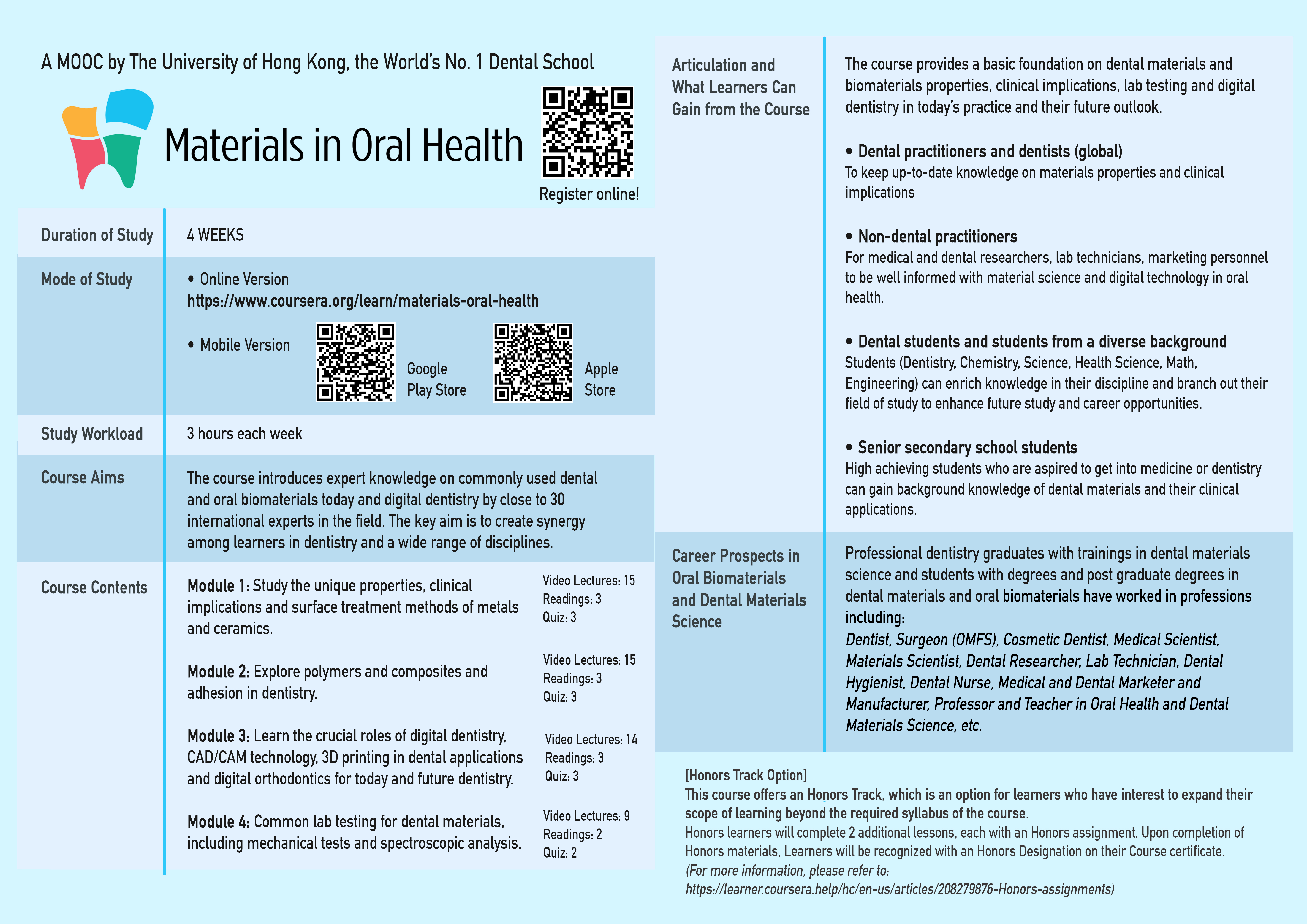
Explore the “secrets” of dental materials and digital dentistry together in the Materials in Oral Health MOOC offered by the best dental school in the world.
We all need healthy teeth, don’t we? Have you ever wondered why titanium, ceramics and some synthetic polymeric materials are the “materials of choice” in oral health care? What are the “secrets” that make these materials so special for dental implants and other restorative procedures?
HKU Dentistry ranking No. 1 in the World has the vision to bring together the expertise and best practices in dental materials and biomaterials in the rerun of the MOOC Materials in Oral Health. The course is taught by a professional team of 30+ local, regional and international dentistry professionals and experts in dentistry and dental materials. What does this course cover? This 4-week Oral Biomaterials course unveils the exciting and unique properties and clinical implications of some state-of-the-art dental materials, including titanium, zirconia and modern synthetic polymer-based composites. We are also going to look at the crucial roles of CAD/CAM technology and 3D printing in dental application and digital orthodontics.
Oral biomaterials today is an exciting area encompassing contributions from professional dentistry to biology, chemistry, physics, material science, mathematics and engineering. Whether you are dental practitioners and dental technicians, non-dental practitioners, dental students, university students from various disciplines, or senior secondary school students – this course will open your eyes to the magic of dental materials science. If you are a prospective university student, this course can open up new and exciting opportunities possibly leading to new career paths.
Join us in the upcoming Materials in Oral Health MOOC on 22 March 2019 (HKT)!
Modern Composites – An Overview of Fibre-Reinforced Composite (FRC) in
Dentistry; Fibre-Reinforced Composite (FRC) : Chemistry, Properties, Fibre Types and Orientation; Applications of Fibre-Reinforced Composite (FRC) in Dentistry
Clinical Material of Choice – Classification and Composition of Resin Dental Adhesives; Resin Adhesion to Tooth Tissues; Indications of Resin Dental Adhesives
Sneak Previews
Have a taster of what will be taught in this course!
(Sneak preview playlist here.)
The Application of Silicon and Silicon Compounds in Dentistry – Prof. Jukka Pekka Matinlinna
– “Silicones find a wide range of biomedical applications…”
Dental Material Choice: Zirconia vs Titanium – Prof. Niklaus P. Lang
– “Shortcomings with titanium are mostly aesthetic in nature…”
What is Digital Dentistry? – Dr. James Tsoi
– “Digital dentistry is one of the emerging fields in dentistry…”
Materials used in Implants – Dr. Nikos Mattheos
– “Osseointegration is a remarkable story of scientific discovery…”
(This is an event co-organized by Technology-Enriched Learning Initiative and Faculty of Law.)
Live Streaming
Details of the event:
Date : 20 September 2018 (Thursday) Time : 9:30am to 1:00pm Venue : Academic Conference Room, 11/F Cheng Yu Tung Tower, Centennial Campus, HKU (A LIVE streaming room (CCT-7.24-CCT-7.25) will be open when the main venue is full.)
Abstract
Issues around feedback, both formative and summative, require meticulous pedagogical considerations. While it is widely agreed that feedback should advance learning, as opposed to merely explaining and justifying grades, the reality does not always reflect such aspiration. Reasons may vary from ineffective feedback format and mechanism, delayed feedback with little or no relevance to further learning, lack of student engagement in the feedback, or sometimes feedback inconsistent with assessment and learning outcomes. Moreover, there is also such concern of too much feedback, creating teacher-dependent learners and learning style. In this symposium, speakers across different faculties and disciplines will share their experiences in addressing feedback issues with pedagogical strategies and technologies.